
2.5 KiB
A Simple SdFat Audio Player
It was pretty simple to build a simple audio player with the help of the Stream API. A SD file is a sublass of an Arduino Stream, so all you need to do is to copy from the file to the desired output strem. Finally you need to add some logic which handles the end of file to automatically process the next file and maybe a status flag to halt and contine the processing. In addition it adds only a little bit of additional complexity to add volume control and meta data support.
In order to simplify things, I decided to provide this functionality as well and to prove the point: The AudioPlayer class took only 120 lines of code to implement!
The AudioPlayer supports
- multiple processor architectures
- multiple audio data sources (SD, URL, callbacks)
- different Output Scenarios (I2S, PWM, A2DP etc). Just pass the desired output stream object to the constructor.
- different Decoders for MP3, AAC, WAV. Just pass the desired decoder object to the constructor.
- Volume Control (by calling player.setVolume())
- Stopping and Resuming the processing (by calling player.stop() and player.play())
- You can move to the next file by calling player.next();
- support for Metadata
The example demonstrates how to implement an MP3 Player: which provides the data from a SD drive and provides the audio via I2S as anlog output: The AudioSourceSdFat class builds on the SdFat Library from Bill Greiman which provides FAT16/FAT32 and exFAT support.
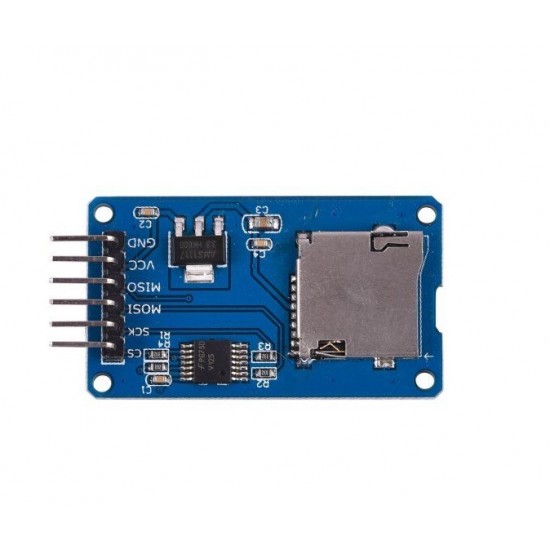
SD Card
Here is the information how to wire the SD card to the ESP32
| SD | ESP32 |
|---|---|
| CS | VSPI-CS0 (GPIO 05) |
| SCK | VSPI-CLK (GPIO 18) |
| MOSI | VSPI-MOSI (GPIO 23) |
| MISO | VSPI-MISO (GPIO 19) |
| VCC | VIN (5V) |
| GND | GND |
Output Device: Piezo Electric Element
To test the output I am using piezo electric elements
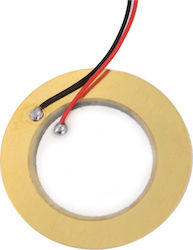
It should also be possible to connect a headphone to the output pins.
| PIEZO Left | ESP32 |
|---|---|
| + | GPIO25 |
| - | GND |
| PIEZO2 Rigt | ESP32 |
|---|---|
| + | GPIO26 |
| - | GND |